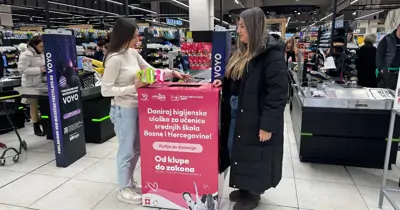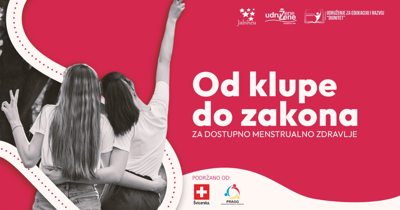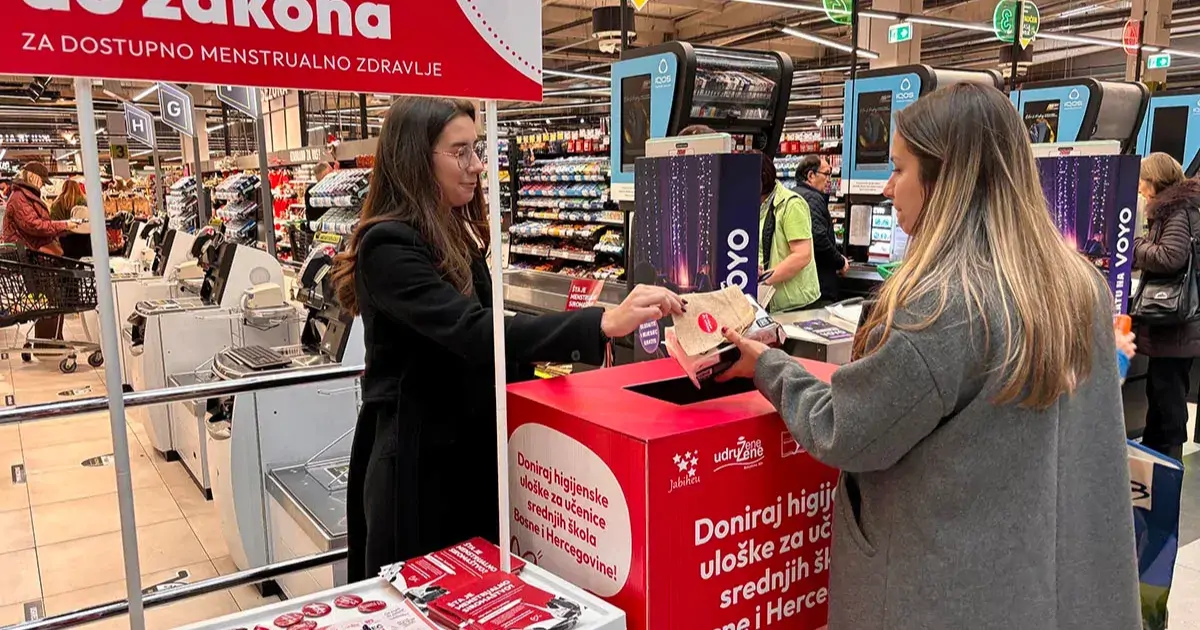
Today, at the Bingo City Center in Sarajevo, the association "Ja bih u EU" (JaBiHEU) launched a three-day humanitarian campaign to collect sanitary pads for female students at three high schools in Bosnia and Herzegovina, as part of the project "From the Classroom to Legislation – For Accessible Menstrual Health."
The campaign is taking place from November 26 to 28, 2026, to provide tangible support to female students, while also raising public awareness about the issue of "period poverty" and the need for a systemic solution. On the first day of the campaign, with the assistance of volunteers, members of the public have the opportunity to donate sanitary pads, discuss the importance of menstrual health, and learn about initiatives that partner organizations have submitted to the relevant institutions in the Federation of Bosnia and Herzegovina and Republika Srpska. "Through the project 'From the Classroom to the Law – For Accessible Menstrual Health,' we aim to shift the issue of menstrual health from a state of limited visibility into the realm of concrete social change and systemic solutions. So far, we have submitted initiatives to the relevant authorities to introduce free menstrual hygiene products for all female high school students in Bosnia and Herzegovina, organized five street-based campaigns in various cities, developed an educational digital platform called 'Digital Clinic' (Digitalna klinika), and carried out numerous educational activities—both in-person and online. All these efforts share a common goal: to help reduce 'period poverty,' foster a more informed society, and create conditions where menstruation is no longer a barrier to the education, dignity, and equal opportunities of young women.
However, we recognize that change cannot be achieved through advocacy alone; it also requires tangible solidarity and support from the community. That is why we are organizing a drive to collect menstrual hygiene products—to provide direct support to students while demonstrating that ensuring access to these products is a shared social responsibility. I invite all citizens of Sarajevo to join us over the next two days, November 27th and 28th, and donate menstrual hygiene products at the Bingo City Center in Sarajevo. Every donated pack represents concrete support for a young woman, as well as a contribution toward a society where menstrual health is not a privilege, but a matter of fundamental dignity and equality," stated Lara Sutović, Project Coordinator at the association JaBiHEU. Period poverty refers to limited access to menstrual hygiene products, information, and adequate facilities for managing menstruation with dignity. The lack of access to these products, insufficient education, and the persistence of stigma can negatively affect the health of girls and young women, their regular school attendance, and their equal participation in society. A key focus of the project is advocating for long-term institutional solutions to ensure that female high school students have access to free menstrual hygiene products.
In the Federation of Bosnia and Herzegovina, partner organizations have submitted an initiative to the Federation Government, the Federal Ministry of Health, the Federal Ministry of Education and Science, and the Federal Ministry of Finance. The initiative proposes incorporating menstrual health and the prevention of period poverty into the implementation of the Federation of BiH Development Strategy 2021–2027. It suggests establishing a mechanism to provide all female high school students in the Federation of BiH with free menstrual hygiene products year-round, including during school holidays.
According to a preliminary financial assessment conducted as part of the project, providing menstrual hygiene products for 35,643 female high school students in the Federation of BiH would require an annual expenditure of approximately 1.71 million KM for the procurement of these items.
In Republika Srpska, the initiative proposes integrating menstrual health and the prevention of period poverty into the Strategy for the Improvement of Sexual and Reproductive Health 2019–2029. ...and the accompanying action plans, which define concrete measures to improve the accessibility of menstrual products, provide education, reduce stigma, and establish sustainable funding mechanisms. Implementing these proposed measures across both entities could reach more than 53,000 female high school students.
Young female volunteers also play a vital role in this humanitarian initiative; their involvement demonstrates the significance of actively engaging young people in addressing social issues that directly affect their peers. "Menstrual products should not be a luxury, but a basic necessity accessible to all girls and women. As a high school student, I believe it is important to speak openly about period poverty and to contribute to change through our actions. I hope that initiatives like this—beyond providing immediate aid—will also encourage the relevant institutions to make menstrual products available for free in schools," noted Lejla Fišek, a volunteer at a humanitarian drive.
Humanitarian drives serve as an important example of community solidarity; however, they cannot replace the responsibility of institutions to ensure the long-term, continuous availability of menstrual hygiene products. For this very reason, partner organizations continue to advocate for systemic solutions, ensuring that no girl is deprived of basic hygiene products due to her financial circumstances.
We invite all citizens to visit the Bingo City Center in Sarajevo over the next two days—November 27th and 28th—and donate menstrual pads by placing them in the designated donation box. Together, we can help reduce period poverty and build a society where menstrual health is a right, not a privilege.