
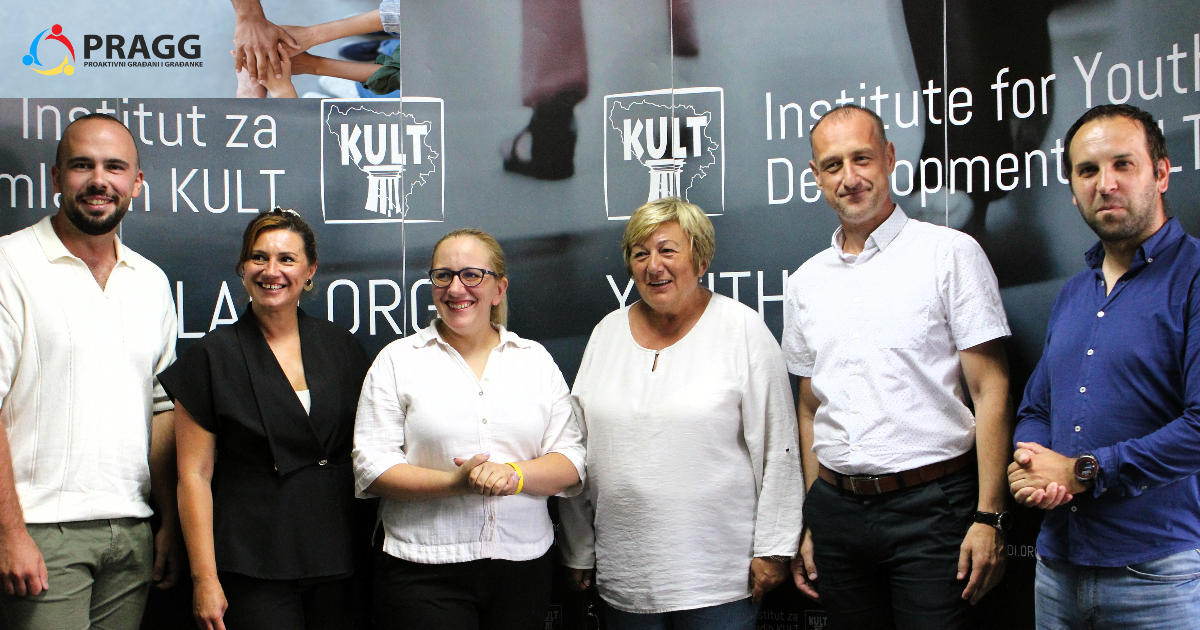
Continuous learning, openness to new ideas, and the willingness to improve one’s work are key to the successful functioning of civil society organisations. This is why the Job Shadowing Programme, implemented by the Institute for Youth Development KULT, one of PRAGG’s local implementers, continues to bring together organisations committed to strengthening their capacities, improving their internal processes, and achieving greater impact in the communities they serve.
This time, the Institute hosted representatives of the DON Citizens’ Association from Prijedor, an organisation that has been working for nearly three decades to strengthen civil society, empower citizens economically, protect consumer rights, develop communities, and promote active citizenship. Through its work, the association strives to engage citizens in social processes and contribute to the development of local communities across the country.
During the one-day Job Shadowing Programme, participants had the opportunity to learn more about the Institute’s organisational structure, project planning and management processes, internal procedures, monitoring and evaluation practices, as well as approaches to presenting results to the public and partners.
A particular value of the visit was the open exchange of experiences on the challenges and opportunities that civil society organisations encounter in their everyday work.
"Regardless of how long we have been working in civil society, there is always room for learning. Exchanges like this remind us that organisations grow when they are willing to reflect on their own processes and learn from one another," said Murisa Marić, Executive Director of the DON Consumer Protection Association from Prijedor, following the visit.
The discussions covered various topics related to organisational development, human resource management, improving procedures, and more efficient use of available tools. Participants highlighted that it was particularly valuable to see how certain processes are developed, tested, and improved over years of work, and how experiences can be adapted to organisations with different capacities.
"It is not enough to do good things – it is also necessary to know how to present the results of our work. When citizens see the impact of what we do, our efforts gain their full meaning and value," Marić emphasised.
The Job Shadowing Programme provides organisations with an opportunity to gain new knowledge through direct experience and identify practical solutions to challenges they face in their daily work. At the same time, it encourages networking among organisations, strengthens mutual trust, and contributes to the development of a stronger and more resilient civil society in Bosnia and Herzegovina.
"We are leaving this meeting with new knowledge, ideas, and motivation. We are confident that the experiences we exchanged today will help us improve our processes and continue building an organisation that better responds to the needs of the people we work for," representatives of the DON Association said.
Once again, Job Shadowing proved to be much more than a professional visit. It is a space for sharing knowledge, gaining inspiration, and jointly reflecting on how organisations can become even more successful in achieving their missions. The knowledge gained through such exchanges does not remain within a single organisation – it is transferred further, into local communities, among citizens, and into processes that create positive changes in society.
The DON Citizens’ Association is a partner organisation participating in the PRAGG project, funded by the Government of Switzerland and implemented by a consortium consisting of HELVETAS and NIRAS in Bosnia and Herzegovina, together with local partners the Centres for Civic Initiatives (CCI) and the Institute for Youth Development KULT.