
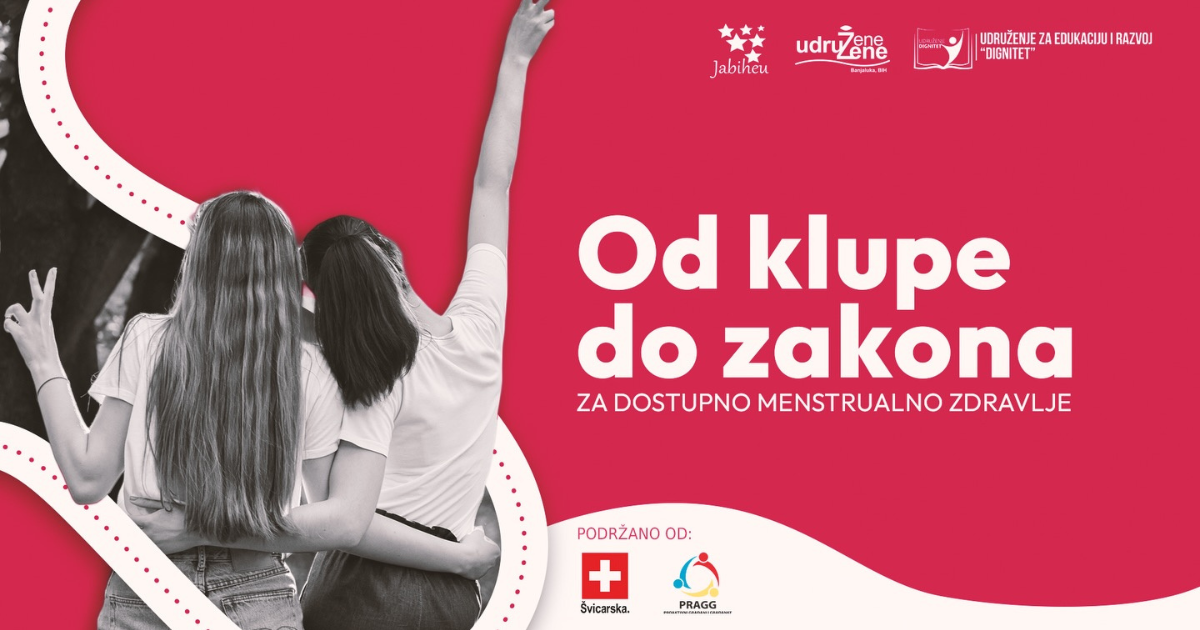
In Bosnia and Herzegovina, there is no law, specific public policy, or budgetary mechanism that directly addresses menstrual poverty, although this problem affects a large number of girls and women across the country. That is why, with the support of the PRAGG project, three organizations from Bosnia and Herzegovina, the Association "Ja BIH u EU" Sarajevo, the Foundation "United Women" Banja Luka and the Association "Dignitet" Mostar, through the initiative "From the Bench to the Law - for Accessible Menstrual Health" are trying to open an institutional dialogue on a problem that, as they claim, has never been systematically addressed.
According to data provided by organizations gathered around the initiative "From the Bench to the Law - for Accessible Menstrual Health", more than 200,000 young people, aged 13 to 25, in Bosnia and Herzegovina, face a lack of access to menstrual products and information about menstrual health. The problem is further exacerbated by economic inequalities, lack of education, and entrenched social taboos.
“Menstrual poverty is a direct reflection of economic inequalities. Girls from poorer and rural areas suffer the most, not only due to the inability to afford products, but also due to poorer access to information, health services, and adequate conditions in schools,” the representatives of the initiative state.
They add that in practice, this means that some girls continue to use one pad, miss school, or avoid social activities due to the lack of basic hygiene products and feelings of shame, and warn that such situations are often viewed as individual problems, although they actually represent a consequence of systemic inequality and institutional ignoring of the topic.
“This means that some girls in the 21st century continue to choose between basic needs, miss school, or risk their health. This is not an individual problem; it is a clear indicator of systemic inequality,” they point out.
Although menstruation affects almost half of the population, the issue of menstrual health in BiH has not been seriously integrated into the education system, health strategies, or budget policies to date. This is precisely where they see the key problem.
"For decades, menstruation has been treated as something that is not talked about, which automatically meant that problems related to it were not discussed, neither in public nor in institutions. This combination of stigma and silence has produced a complete political invisibility of the problem," the initiative states.
A topic that is not present in the public space can hardly become a priority for institutions. That is why the organizations gathered around the project are trying to take menstrual health out of the private sphere and position it as a matter of public interest, health care, education, and dignity. They state that their goal is not only to raise awareness, but also to make concrete changes in public policies. The project advocates the inclusion of menstrual health in entity strategic documents, the introduction of budget allocations for menstrual products in schools, and the creation of long-term institutional support mechanisms.
“Dignity should not depend on donations. Humanitarian actions can help in the short term, but they do not solve the problem. If we want real change, we must have a system that guarantees access to menstrual products as the standard, not the exception,” say the representatives of the initiative.
The issue of institutional responsibility is one of the central points of the campaign. The representatives of the initiative believe that menstrual health should not remain exclusively a topic of the non-governmental sector and occasional humanitarian actions.
“It is very important to emphasize that this is not a question of the goodwill of institutions, but of their responsibility towards citizens,” they state.
Over the past months, the organizations have held a series of meetings with educational and health institutions, including the Federal Ministry of Health, as well as schools and health facilities. They state that they discussed with representatives of the Federal Ministry of Health the possibilities of including the topics of menstrual health and menstrual poverty in strategic documents, while they discussed with schools the education of young people and the inclusion of female students in project activities.
A special focus was placed on work with young people. Through online workshops on menstrual health and menstrual poverty, the initiative, according to the organizers, brought together more than 100 young people from different cities in Bosnia and Herzegovina. The topic was the menstrual cycle, health aspects of menstruation, stigma, and the impact of menstrual poverty on everyday life and education. The organizers claim that it is precisely the inclusion of young people
represents one of the key elements of the campaign.
"Menstrual health is not a luxury. It is a basic issue of dignity, health, and equal opportunities," they said when launching the initiative.
However, the question that remains open is how much the institutions are really ready to turn a problem that has been ignored for years into a concrete public policy. Representatives of the initiative claim that some institutions first encountered the concept of menstrual poverty only through meetings. This is precisely why they believe it is important to continue public pressure and civic engagement.
"The fact that something is not talked about does not mean that the problem does not exist; on the contrary, it means that its consequences are even deeper and more long-lasting", they warn.
For the organizations involved in the project, success will not only represent the visibility of the topic in the public, but also concrete systemic changes.
"This means that menstrual health is clearly recognized in public policies, that there are specific budget lines, and that young people in schools have safe and dignified access to products. In parallel, success is also a society in which menstruation is no longer a taboo, but a normal part of public conversation," the representatives of the initiative conclude.