
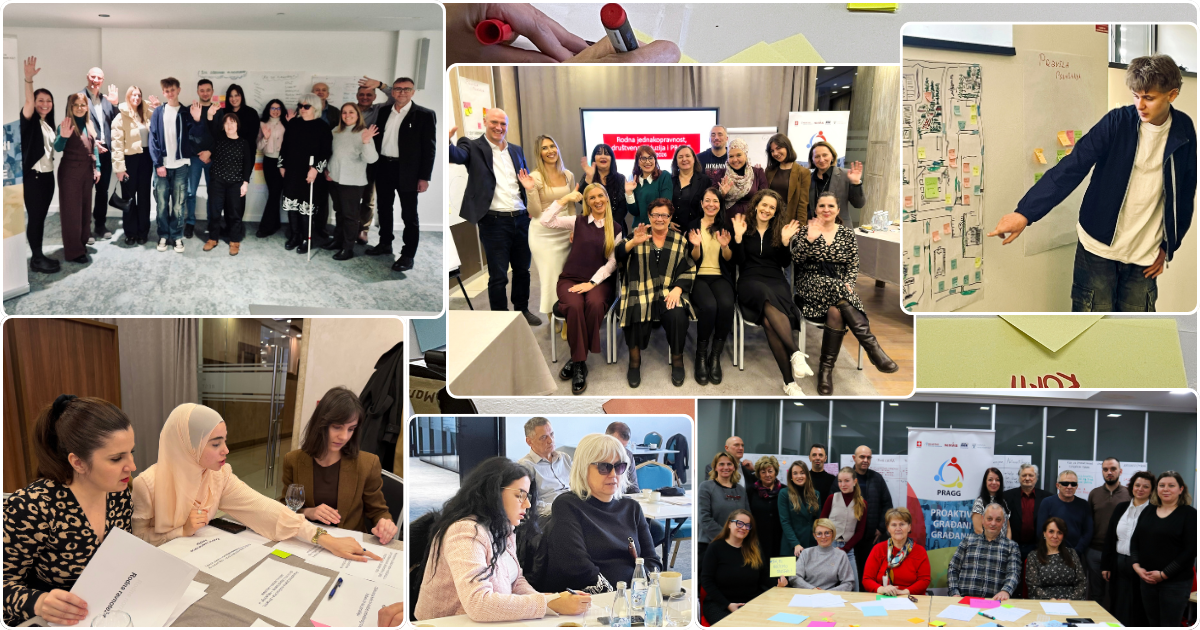
In January and February 2026, three cities — Tuzla, Banja Luka, and Mostar — hosted conversations that went far beyond project plans, logical frameworks, and formal documents. They were conversations about who is included — and who might still be left out. About how to recognize the quiet challenges that never appear on paper, yet deeply shape people’s daily realities. And about how to make projects truly accessible to everyone they are intended to serve.
This was precisely the purpose of the internal GESI workshops organized within PRAGG: to create space for learning, exchange, and honest reflection on our own practices. Because gender equality and social inclusion are not add‑ons to projects. They are their foundation.
“The most useful part for me was identifying and naming barriers and connecting those barriers to specific groups and categories,” shared Nataša Kurtuma from the Lara Foundation Bijeljina, recalling the workshop in Tuzla. “When we visually map the current situation and the obstacles we may encounter, it becomes easier to fully understand what we might face during implementation.”
Her words remind us of a simple yet often overlooked truth — that inclusiveness begins long before the first activity takes place. It starts with the questions we ask while planning. Who can participate? Who maybe cannot — and why? And what can we do to change that?
A similar appreciation for shared learning and collective understanding was expressed by Lana Zec from the Prnjavor Youth Center, who joined the workshop in Banja Luka. “The introductory part, where we revisited concepts such as equity and equality, was especially valuable,” Lana said. “These terms are often used, but not always in the same way. Having that shared starting point — understanding what we are talking about — was extremely important.”
When people from different organizations, generations, and backgrounds sit together, they exchange more than knowledge. They exchange perspectives. They learn from one another. They begin to notice things they may not have seen before.
For Mersiha Čomor from the Center for Psychological Support ‘Sensus’ in Mostar, this was one of the workshop’s key takeaways. “The workshop reminded me of something we often unintentionally overlook: that our activities, though well‑intentioned, may not be equally accessible to everyone,” she shared. “Inclusion must not remain a declarative value — it has to be an operational principle that runs through every aspect of our work.”
This is a process that requires openness — the willingness to pause, reflect, and learn. Not because we are doing something wrong, but because we want to do better.
Such an approach is deeply rooted in the values supported by the Swiss Embassy in Bosnia and Herzegovina. As emphasized by Snežana Kanostrevac‑Cvijetić, Programme Manager at the Embassy of Switzerland: “The principle of citizen participation is a key element of democratizing society, ensuring that no one is left behind. For the Swiss Embassy, it is therefore essential that gender equality and social inclusion are systematically integrated into every project the Embassy supports.”
This is also at the core of the PRAGG approach — continually strengthening partners’ capacities while creating space where experiences are shared openly and knowledge is built collectively.
As explained by Ljupka Simonoska Schulz on behalf of the PRAGG project team, the goal of the workshops was “to create a space for grant recipients to exchange experiences and to learn practices and approaches they can apply to make their campaigns and future projects more inclusive.” The organizations involved in PRAGG work directly with citizens — young people, persons with disabilities, parents, older adults, and all those whose voices must be heard.
Planning with people, for people
When knowledge is shared, trust grows. When challenges are recognized, they become solvable. And when projects are planned with people and for people, they stop being just activities — and become part of real change.
The GESI workshops were not merely spaces for learning. They were a reminder that inclusion is not a goal achieved once, but a journey taken together. Step by step. Conversation by conversation. Project by project.
The workshops became more than scheduled sessions — they transformed into spaces where participants paused, reflected, and envisioned how their work could become stronger and more inclusive. Conversations flowed naturally, guided by principles of gender and social equality, helping participants view their ongoing and future engagement through a new lens.
Gradually, the space shifted: from a group of individuals into a community. Participants discovered each other’s stories, the campaigns they lead, and the motivations that drive them. New connections emerged, ideas intertwined, and the first foundations for joint activities and future cooperation were set.
That’s why the PRAGG GESI workshops in Tuzla, Banja Luka and Mostar were so special: they brought together people working with diverse communities and opened honest conversations about who we include, who we might be missing, and how our activities can become more accessible to everyone.
Through practical examples, joint learning and a lot of mutual understanding, participants reminded one another of something essential: inclusion is not a box we tick — it is a process.
And every step, no matter how small, can open a door for someone!
Please wait...