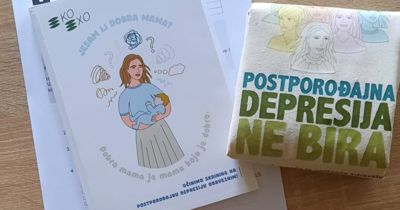

“As someone who experienced a severe form of postpartum depression after giving birth, I can personally attest to how important this issue is and how much systemic support is lacking. My path to recovery was long and demanding and, unfortunately, included hospitalization, which I initiated myself, fully aware that I needed professional help. This is precisely why I experience this initiative as something deeply personal and emotionally important.”
This is not an isolated case. This is the reality faced by many women in Bosnia and Herzegovina—women who, instead of being timely recognized and supported by the healthcare system, are forced to take responsibility themselves for surviving the most vulnerable period of their lives.
It is precisely because of such experiences that, over the past year and a half, we have been working diligently and persistently to introduce mandatory screening for postpartum depression throughout Bosnia and Herzegovina. Postpartum depression does not discriminate—but the system, unfortunately, still does, deciding who will receive support and who will not.
Screening for postpartum depression is a simple, effective, and internationally recommended measure that enables early identification of symptoms and timely referral to professional care. Its absence represents a missed opportunity to prevent more severe forms of the illness, long-term consequences for mothers’ mental health, and negative impacts on child development and family functioning.
Through our initiatives, we clearly affirm that every woman in Bosnia and Herzegovina has the right to equal mental health care, regardless of where she lives.
Just over a year ago, we submitted an initiative to the Ministry of Health and Social Welfare of Republika Srpska to reinstate mandatory postpartum depression screening within the healthcare system. In June last year, the Ministry adopted the Mental Health Promotion Program for Citizens for the period 2025–2027, together with an Action Plan regulating the implementation of screening in healthcare institutions across Republika Srpska. This step demonstrates that systemic change is possible when there is political will.
At the same time, we submitted an initiative to introduce mandatory screening to the Federal Ministry of Health. Despite verbal assurances that a legal framework for screening would be developed, we have still not received an official response to our initiative submitted in June last year. It is particularly concerning that the Parliament of the Federation of Bosnia and Herzegovina, which submitted the same initiative, has also not received a response to date.
In the Brčko District of Bosnia and Herzegovina, following multiple meetings and the submission of an initiative, the Government of the Brčko District has initiated the process of developing a Mental Health Promotion Program and an accompanying Action Plan, which will regulate the implementation of postpartum depression screening. We see this process as an important step toward establishing equal standards.
However, as long as access to screening depends on administrative boundaries, mothers in Bosnia and Herzegovina remain unequally protected.
“Behind every initiative are real women and real stories. Screening is not a bureaucratic issue—it is a matter of prevention, dignity, and basic healthcare. We will not give up until postpartum depression screening becomes mandatory and accessible to every woman across Bosnia and Herzegovina.”
Our fight continues—because no mother should be left to face this struggle alone at the moment when she needs help the most.
The campaign “Advocating for the Introduction of Postpartum Depression Screening in Bosnia and Herzegovina” is implemented in cooperation with partner organizations: the Association for Education and Development Dignitet (Mostar), the Association of Families Facing Infertility Bebe (Trebinje), and the Association of Active Women Gender (Brčko).