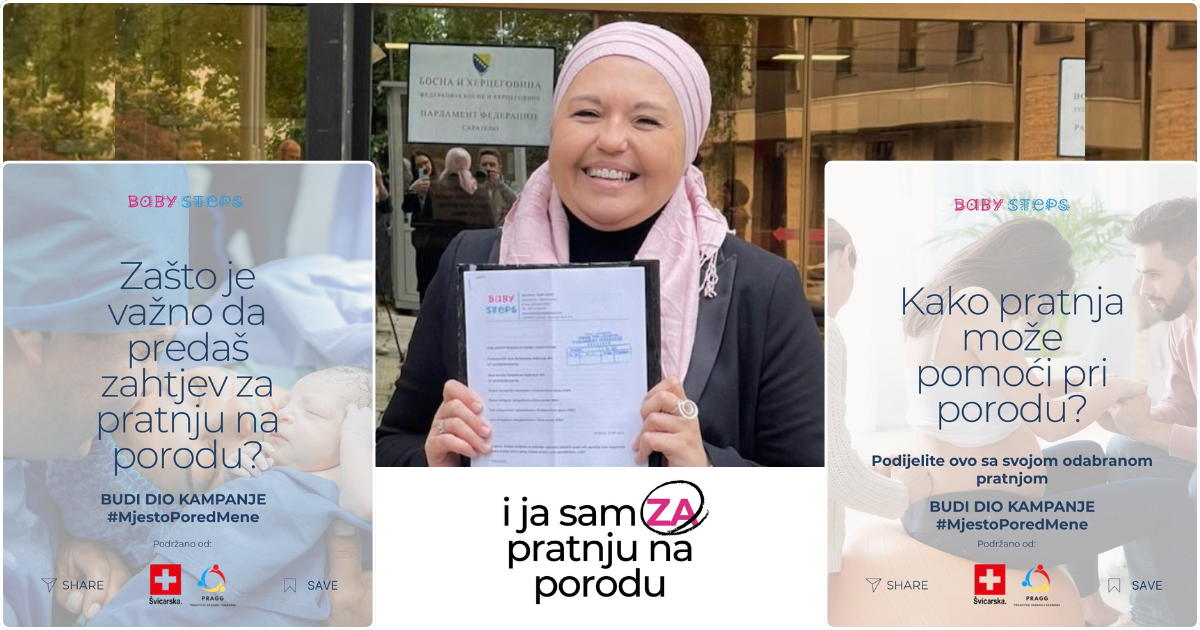
On the occasion of Human Rights Day, we wish to highlight one of the most important struggles for women’s dignity in Bosnia and Herzegovina — the right of a woman in childbirth to have a trusted companion by her side. The initiative implemented by the Association Baby Steps, with the support of PRAGG, has already brought visible changes: the presence of a birth companion is no longer viewed as a privilege, but as a human right; women increasingly seek information and support during childbirth; healthcare workers are more openly discussing birth companionship; and the process has even entered official institutions — the Proposal for Amendments to the Law on Patients’ Rights has been submitted to the Parliament of the Federation of BiH, marking the first such step in our country.
These changes show that the initiative has already altered behavior — in maternity wards, within families, and in society at large. But the struggle is not over. In a conversation with Amila Tatarević, President of the Association Baby Steps, we explore what has truly been achieved, how these changes came about, and what still needs to be done to ensure that dignified childbirth becomes a legally guaranteed right for every woman in the Federation of BiH.
Could you briefly introduce the Baby Steps initiative and the current status of the struggle for the right to a birth companion?
“Throughout all our research — on conditions in maternity wards, obstetric violence, corruption, and women’s experiences — the same conclusion kept emerging: having a companion during childbirth changes everything. It brings safety, reduces stress and risks, and builds women’s trust in the healthcare system. It is a matter of dignity and one of the key human rights in childbirth.
For years, we have been collecting women’s experiences, working with healthcare institutions and the medical profession, and participating in the development of professional recommendations in which birth companionship is clearly defined as good practice. But recommendations were not enough — that is why we sought a systemic solution.
With the support of PRAGG, we transformed birth companionship from a medical issue into a broader social one: human rights, safety, prevention of violence and corruption. Today, we are at a crucial moment: the proposal to amend the Law on Patients’ Rights is before the Parliament of the Federation of BiH, and thousands of families actively support women’s right not to be alone.”
What does the right to a companion “from the first contractions to the end of childbirth” actually mean?
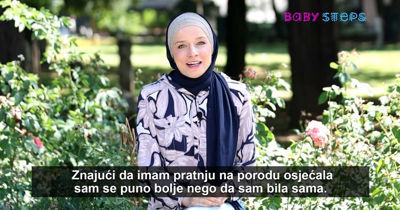
“It means that from the very first contraction, through all stages of labor and until the moment of birth, a woman can have beside her a person she trusts — a partner, mother, sister, or friend. That person is there to calm her, hold her hand, and provide emotional security.
A companion does not change medical procedures, but changes everything that is human: the sense of control, belonging, and safety. It ensures that a woman is not isolated and that she has the support that makes childbirth more humane and safer.”
What effects does companionship have on the mother and the baby?
“The presence of a companion reduces fear and stress in women, making childbirth more natural, often faster and with fewer medical interventions. Babies born to mothers who have companionship experience a more stable start and better health outcomes.
Companionship also reduces the risk of obstetric violence and corrupt practices, as the woman is no longer alone or uninformed. This is also an important social issue: when the birth experience improves, trust in the system grows, as does women’s willingness to give birth — which is crucial in a country with a low birth rate.”
Looking back at the beginning of the Initiative, which three most concrete changes would you highlight as key results so far?
“First, pregnant women began to demand their rights en masse — invoking recommendations and requesting clear procedures from hospitals. That changed the dynamic.
Second, hospitals began to respond to this pressure. The example of Bihać is the clearest: thanks to women’s demands, a procedure for birth companionship was established — the first institutional change ‘from the bottom up.’
Third, we have seen a noticeable change in the behavior of part of the medical staff: more respect, better explanations, and more communication. But without a law, this remains at an individual level — that is why we need a binding systemic solution.”
How have Baby Steps, with the support of PRAGG, most significantly contributed to initiating these changes?
“With the support of PRAGG, we managed for the first time to take birth companionship out of the narrow medical framework and present it as a multisectoral issue — a matter of human rights, dignity, safety, prevention of violence, anti-corruption, and strengthening citizens’ trust in the healthcare system. The medical profession has already spoken: companionship is recommended. There is nothing left to debate in that regard. That is precisely why we focused on all the other dimensions that equally shape the childbirth experience and make it a social, not merely medical, issue.
This broader narrative opened the door to much greater understanding, both in Parliament and among the public. We also received exceptionally strong media support, enormous visibility, and high public interest. What makes us happiest, however, is the awakening of citizens: women, partners, and families who previously remained silent are now reaching out, asking questions, writing, and seeking information and support. This is the foundation of every major social change.
Through campaigns and educational materials, we aimed to explain all of this in a simple and understandable way, showing that this is a change that brings enormous benefits and, in fact, costs nothing. That clarity of the message was key in motivating pregnant women to contact hospitals, and one of the best examples of its direct effect is the case of Bihać. Thanks precisely to the pressure and clear demands of women, Bihać opened the doors to birth companionship and established a procedure — a result stemming from the combination of information, empowerment, and continuous support we provide.
Thus, the greatest contribution of Baby Steps and PRAGG lies in transforming companionship from an ‘individual request’ into a social issue with institutional, civic, and media dimensions. In doing so, we prepared the ground for the next step — a law that will make this change permanent, equally accessible, and binding for all maternity wards.”
Can you share an example where companionship truly changed the course of childbirth?
“The best example is the experience of a woman who gave birth to two children in Germany, within a system where companionship is considered part of safe childbirth. Through induced labor, uncertainty, and fear, the emotional presence of her partner proved crucial — not instead of medical support, but alongside it.
Although the medical staff were professional and attentive, she emphasized that nothing can replace having ‘someone of your own’ by your side. That sense of safety pushed away fear, accelerated the labor, and turned it into an empowering experience. That is exactly what many maternity wards in BiH are missing — not medical professionalism, but the humanity and support that companionship brings.”
The draft law has been submitted to the Parliament of the Federation of BiH. What does this step mean for the struggle for this right, and do you see it as a turning point for systemic change?
“This is a historic step. Birth companionship is no longer a matter of a hospital’s goodwill, but potentially a legal right of every woman. Responsibility thereby shifts to institutions, instead of women who until now had to plead, explain, and hope they would ‘catch the right shift.’
If Parliament adopts the law, companionship becomes a binding standard and the foundation of the human right to dignified childbirth.”
What is the next most important goal of the Initiative, and what is, in your opinion, crucial for companionship to become standard practice in all public maternity wards in the Federation of BiH?
“Our next and most important goal is the adoption of a law that will clearly, unambiguously, and universally guarantee the right to companionship during childbirth. But it is equally important to emphasize: the law is only the beginning. It is the foundation, not the end of the process. True change comes only when the law is consistently implemented, when all hospitals comply with it, and when clear oversight mechanisms are established.
The right to companionship is not merely a technical issue — it is probably the greatest step forward in improving maternity ward conditions in recent decades. Companionship reduces fear, elevates dignity, makes childbirth more humane, and also acts as a strong shield against violence and corruption. That is why this right is so symbolic: it represents the first visible point at which the state tells a woman — we see you, we hear you, your experience matters, and we protect you.
In this phase, once the law is adopted, we expect and believe that the medical profession will respond — by making implementation simple, clear, and swift, because there are no longer any obstacles or excuses. All medical recommendations already exist, all scientific facts are unquestionable, and social support is enormous.
Therefore, we are convinced that the adoption of the law — together with professional commitment and consistent implementation — will be the final driver of lasting change that will make companionship a universal, everyday, and unquestionable practice in all public maternity wards in the Federation of BiH.”
On International Human Rights Day, we are reminded that the changes we build through PRAGG stem from a simple yet fundamental principle — that every person has the right to dignity, respect, and fair treatment in every interaction with public institutions. Whether it concerns access to services, clearer communication, or the treatment of the most vulnerable, the essence of our work is always the human being.
Small changes in behavior — in how we listen, include, or support people — often create the greatest improvements in the quality of their lives. Human Rights Day therefore reminds us of what PRAGG strives to strengthen every day: a system in which trust is built through actions, and institutions become places where rights are not merely assumed — but actively protected.