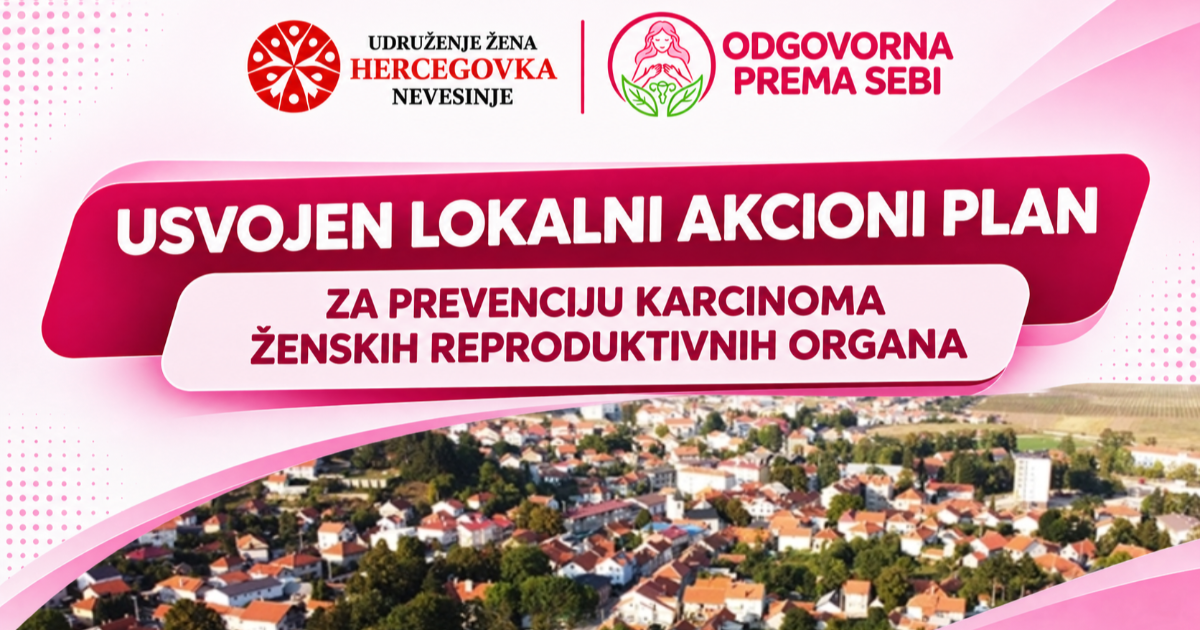
Thanks to the months-long efforts of members of the “Hercegovka” Women’s Association, the Nevesinje Municipal Assembly adopted the Local Action Plan for the Prevention of Cancers of the Female Reproductive Organs at its session held on November 18, 2026. This decision marks an important step towards ensuring that women’s healthcare, timely medical examinations, and prevention become an integral part of the long-term work of local institutions.
The Assembly’s decision is the result of an initiative launched by members of the “Hercegovka” Women’s Association, who sought to ensure that cancer prevention, regular gynecological examinations, and timely access to information for women would no longer depend solely on occasional campaigns and individual activities, but instead become part of continuous and organized efforts to protect women’s health in Nevesinje.
Through the “Responsible for Myself” campaign, members of the Association spent months raising awareness about the importance of preventive examinations and early detection of cancers of the female reproductive organs, while advocating for the adoption of a policy document that would enable local institutions to take a more active role in preventing these diseases.
FROM A CITIZENS’ INITIATIVE TO A MUNICIPAL ASSEMBLY DECISION
The path towards adopting the Local Action Plan involved a series of educational and advocacy activities, discussions with relevant stakeholders, and the organization of a roundtable that highlighted the importance of regular gynecological examinations, early disease detection, and the need for stronger institutional support.
During the campaign, the initiative also received the support of the Mayor of Nevesinje Municipality. The proposed Local Action Plan was submitted to the Municipal Assembly for consideration, and its adoption transformed months of dedicated efforts by local women into a concrete institutional decision. This demonstrates that organized civic engagement by women can contribute to shaping public policies that directly affect the quality of life of local residents.
For women in Nevesinje, the adoption of this document establishes a foundation for continuous education, better-organized preventive activities, and stronger cooperation among relevant institutions in protecting their health. Rather than relying exclusively on individual initiatives and occasional activities, the Local Action Plan creates opportunities for a more sustainable, long-term approach to prevention, in which women’s health is recognized as an important priority for the local community.
“For us, this is not simply about the adoption of a document, but about the hope that women in Nevesinje will receive greater support when it comes to their health. We are well aware of how often women put their own health last because of everyday responsibilities, caring for their families, or a lack of adequate information. We want that to change. We want every woman to understand the importance of timely medical examinations, to have the support she needs to take care of herself, and to ensure that no disease is detected too late because of insufficient information or a lack of prevention. That is why today’s decision means so much to us. Behind it are months of our work, but above all, a desire to do something meaningful for the women who live here — our mothers, sisters, daughters, and friends. We believe this is the beginning of changes that will truly make a difference in their lives,” representatives of the “Hercegovka” Women’s Association stated.
FROM GACKO TO NEVESINJE: CIVIC ACTIVISM DELIVERS RESULTS
With the adoption of the Local Action Plan, Nevesinje has become the second local community where a women-led initiative supported through the PRAGG project has resulted in the adoption of this important document.
Previously, thanks to an initiative by the “Riječ” Women’s Association, Gacko became the first municipality in Bosnia and Herzegovina to adopt a Local Action Plan for the Prevention of Cancers of the Female Reproductive Organs for the 2026–2030 period.
Although operating in different local communities, members of both associations shared a common goal: to ensure that protecting women’s health is not viewed solely as a matter of individual responsibility, but also as an obligation of institutions capable of providing systematic support for prevention.
The examples of Gacko and Nevesinje demonstrate that civic activism can lead to concrete institutional changes. At the same time, they highlight the importance of cooperation between civil society organizations and local authorities in identifying citizens’ needs and adopting decisions that respond to those needs