The right not to wait in line when caring for a child with a developmental disability requires your full attention. The possibility to park your car in the immediate vicinity of the health facility where you are bringing a sick child. Seemingly small changes, but for many families they mean less stress, fewer obstacles, and easier access to everyday services. Such changes were initiated by citizens' initiatives in Breza and Trebinje, implemented with the support of the PRAGG project - Proactive citizens.
Although they dealt with different problems, these two initiatives had a common goal: to adapt existing practices to the real needs of citizens and to show that the local community can be more accessible when institutions, civil society organizations and citizens themselves jointly search for solutions. Their results show that change does not always have to entail large infrastructure projects or complex reforms. Sometimes it is enough to recognize the obstacle that certain families face every day and change the way the community responds to it.
Breza: When advantage becomes the rule, not the exception
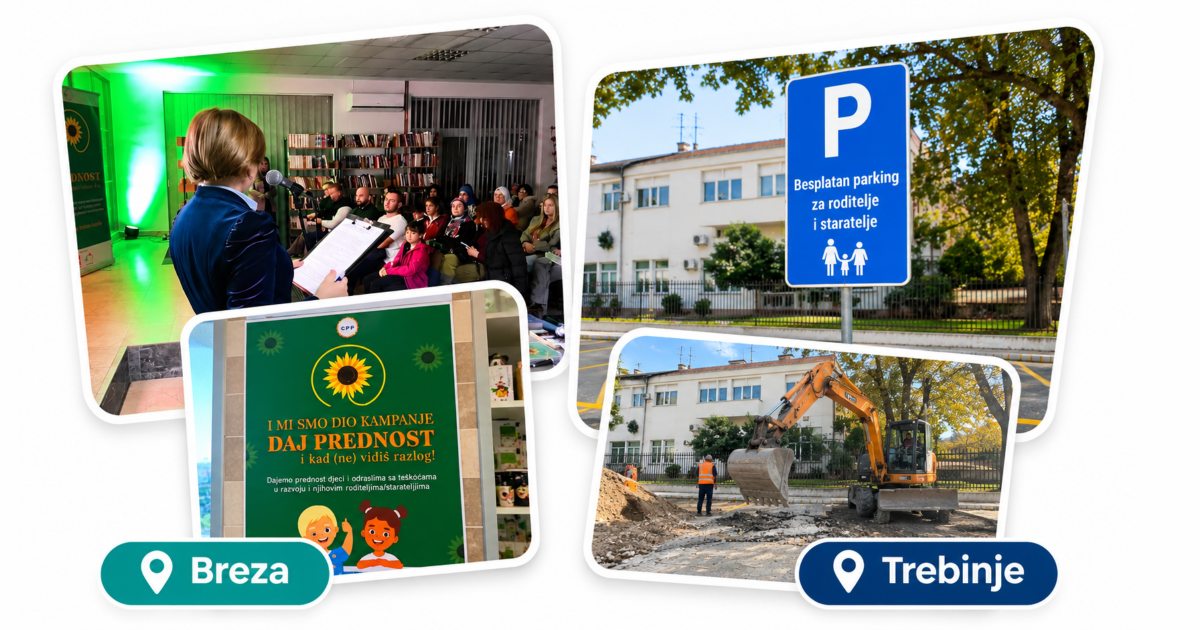
For parents of children and people with developmental disabilities, going to the post office, pharmacy, or other institution is often much more demanding than it seems at first glance. Waiting in lines, unsuitable spaces, and the need for constant care of the child can turn even the simplest obligations into an additional source of stress. The initiative "Give Priority, Even When You (Don't) See a Reason", launched in Breza by the Center for Positive Practice with support from the PRAGG project, grew directly out of the experiences of parents.
As Ilma Omerhodžić, president of the Association, explained in an earlier conversation with PRAGG, it was particularly important to highlight the needs of families whose challenges are not always visible to others: "Before this initiative, there were no official notices regarding priority for these families. Families with children who had obvious disabilities were often granted priority—especially if the child was restless—but recently, we have seen an increase in our community of children with autism, which is not immediately apparent. It was precisely for the sake of these children and their families that we launched this initiative."
This advocacy effort resulted in the establishment of priority access for parents and guardians of children and individuals with developmental disabilities within public institutions and enterprises founded by the Municipality of Breza.
When Private Companies Join the Change
Although the initiative was primarily focused on public institutions, support also arrived from the private sector. "Apoteke Sarajevo" (Sarajevo Pharmacies) were among the first to accept the call, followed by other local companies.
According to Ilma Omerhodžić, they were especially surprised when some business owners reached out on their own initiative, expressing a willingness to adapt the way they provide services. This level of response demonstrated that the initiative went beyond a mere formal request to the local authorities. It created an opportunity for other stakeholders to re-examine their own practices and identify ways to contribute to a more accessible community.
According to the organization, these changes began to influence other activities in Breza as well. During the Youth Games, extra attention was directed toward individuals with developmental disabilities, while students from the "Mehmedalija Mak Dizdar" Mixed Secondary School focused their New Year’s gift-giving campaign specifically on this group.
For the Center for Positive Practices, these developments indicated that the campaign had also helped shift the way the community perceives the needs of these families.
"Changing prejudices is the hardest job in the world, but I believe the Center for Positive Practices is moving in the right direction. We consider the shift in awareness—and the creation of a safer, more inclusive environment—to be the most significant outcome," notes Omerhodžić.
Trebinje: Ten Parking Spaces That Make Daily Life Easier for Parents
While the method of service delivery was changing in Breza, a civic initiative in Trebinje demonstrated the importance of adapting public space to the actual needs of families.
Parents and guardians bringing children to the Children’s Dispensary faced a shortage of suitable parking near the healthcare facility. Searching for an available spot—especially when a child is ill or requires extra attention—added an unnecessary burden.
The "Stop Mobbing" Association highlighted this issue and, in collaboration with partners and with support from the PRAGG project, launched an initiative to secure free parking for parents and guardians of preschool-aged children.
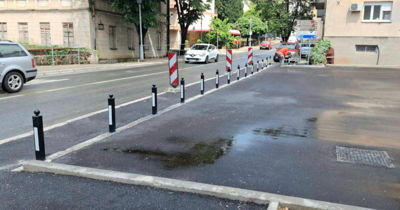
The result was realized in November 2025, when ten free parking spaces were established across from the Children’s Dispensary, including one specifically designated for parents with disabilities. According to the "Stop Mobbing" Association, approximately 1,800 preschool-aged children use the services of the Children’s Dispensary, which further underscores the importance of easier access to this healthcare facility.
"The most significant change is that parents and guardians now have a specifically designated parking area right next to the Children’s Dispensary. This is especially important for parents arriving with babies or young children, carrying baby gear, or bringing a child in for a medical examination while they are ill," notes Anica Ramić from the "Stop Mobbing" Association. This solution makes it easier for parents to attend medical appointments; notably, the parking area was designed with accessibility for parents with disabilities in mind.
While ten parking spaces might seem like a modest achievement at first glance, their true value lies in providing a concrete response to a challenge that families face on a daily basis.
"The value of this project lies not merely in the provision of parking spaces, but in the fact that we identified a problem faced by parents and offered a solution that makes their daily lives easier," the Association states.
From a specific issue to a new approach to citizens' needs
For the "Stop Mobbing" Association, this initiative represents more than just the completion of a single project. It serves as an example of how dialogue between citizens, organizations, and institutions can lead to practical solutions that address the real needs of the local community.
"Our goal is not just to complete a single project, but to foster a culture where citizens' problems are identified promptly and where solutions are sought collaboratively," the Association emphasizes.
At first glance, the right of priority in Breza and free parking in Trebinje may not seem to have much in common. One initiative concerns staff conduct and service organization, while the other relates to the use of public space. Yet, both demonstrate the importance of recognizing citizens' needs through their actual, everyday experiences and addressing them with concrete solutions. In Breza, civil society organizations managed to initiate a change that brought together local authorities, public institutions, and private companies. In Trebinje, a challenge faced by parents evolved into a practical solution, making it easier for them to access healthcare facilities.
When decisions become part of everyday life
The particular value of these examples lies in the fact that civil society organizations succeeded in connecting the experiences of citizens with decision-makers, demonstrating that even relatively simple interventions can improve the quality of life within a local community.
However, for such changes to be truly long-lasting, it is not enough merely to make a decision or establish a new service. These new practices must be embraced and implemented, becoming an integral part of the community’s daily functioning.
As Ilma Omerhodžić from the Center for Positive Practices (Centar pozitivne prakse) summarized: "Authorities can pass a decision, a law, or a regulation, but unless people shift their mindset and act in accordance with these measures, it will all remain nothing more than empty words on paper."
The examples of Breza and Trebinje demonstrate that civic advocacy can drive change—change measured not only by the number of decisions adopted or projects completed, but also by the extent to which communities are willing to recognize the needs of their citizens and adapt their everyday services accordingly.