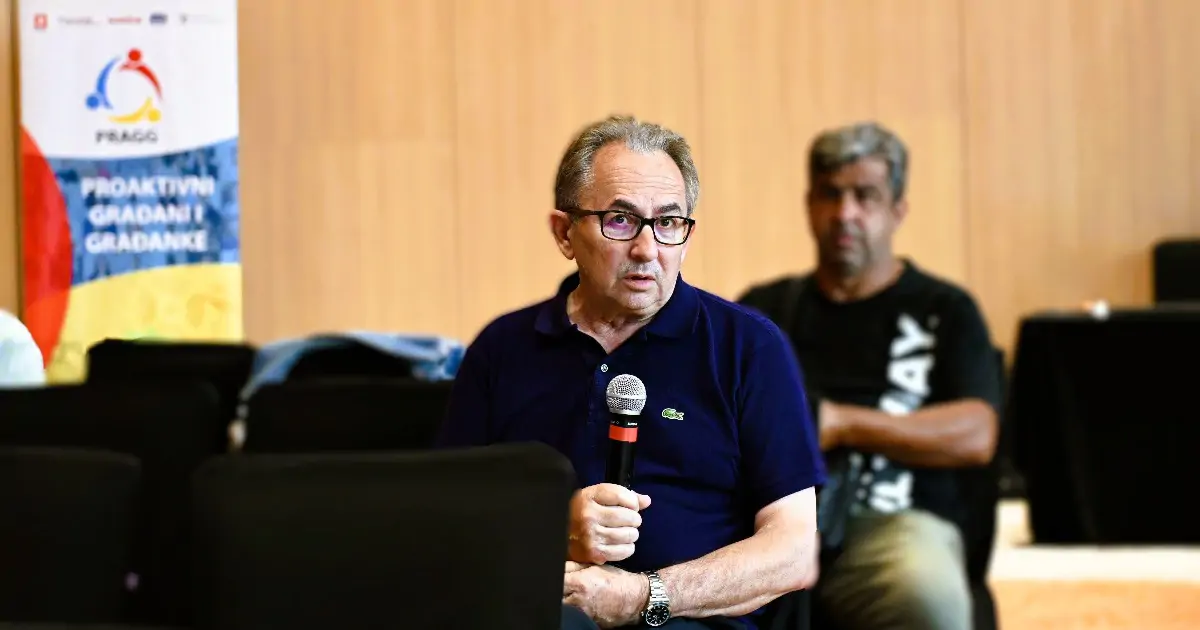
A conversation with Branko Todorović, member of the PRAGG Advisory Board, on dialogue, partnerships, and the kinds of change that matter just as much as tangible results.
“What matters most is that PRAGG demonstrated in practice that cooperation is possible. It didn’t bring people ready-made solutions – it helped them find their own together,” says Branko Todorović, who works with the Helsinki Committee for Human Rights and has been a member of the PRAGG Advisory Board since its establishment.
As a long-time human rights advocate, Todorović believes that the project's greatest value lies not only in addressing specific challenges faced by local communities across Bosnia and Herzegovina, but also in proving that, even in a complex social environment, it is possible to build partnerships and drive meaningful change.
Recognizing What Truly Matters to People
Looking back on the past few years of PRAGG, what would you highlight as its greatest value?
“What stood out to me most was that PRAGG never started with predefined solutions. Instead, it started with the real needs of people in local communities. It is essential to work together with local authorities, civil society organizations, institutions and citizens to identify genuine needs, urgent priorities and areas where meaningful progress can be achieved.
That, in my opinion, is the project's greatest strength. PRAGG worked in many different communities, yet always followed the same approach: listening to local actors, understanding what matters most to each community and finding ways to improve people's daily lives. Sometimes this meant solving a specific problem, while in other cases it meant creating the conditions for long-term solutions.
The needs of Bijeljina are not the same as those of Bihać, Mostar or a small municipality. That is precisely why every community deserves an approach tailored to its own context. When people feel heard and become part of finding solutions, change has a much greater chance of lasting.”
In your opinion, what has this approach demonstrated when it comes to cooperation and partnerships?
“PRAGG has shown just how important it is to build partnerships and create space for dialogue. In Bosnia and Herzegovina this is not always easy, as different stakeholders are often cautious, closed off or simply lack trust in one another. That is exactly why dialogue matters so much.
The project has also demonstrated how successful practices from Switzerland and the wider region can be adapted to the local context in Bosnia and Herzegovina.
To me, this is one of the project's most important lessons: we need to talk to one another, identify shared interests, recognise realistic opportunities for improvement and be willing to compromise. This is equally important for civil society and public institutions alike. In a society like ours, there is simply no progress without dialogue.”
“The Greatest Achievement Is a Model of Cooperation”
Why is it important for successful approaches such as PRAGG to continue beyond the lifetime of a single project?
“Because there is enormous potential for cooperation, while the needs remain significant. Positive examples should not remain isolated success stories; they should become models for future action. I sincerely hope that other donors, as well as institutions across Bosnia and Herzegovina, will become even more willing to support and participate in initiatives like this.
Civil society should not be seen simply as a group seeking financial support for its own ideas. That is not the case. The purpose of that support is to address what genuinely matters to citizens and responds to society's real needs.
Whether we are talking about children and young people, preventing abuse, promoting equality and human rights or protecting the environment, the opportunities for joint action are immense. That is why it is so important for public institutions to demonstrate commitment and work alongside civil society to drive further progress.”
“PRAGG Has Also Shown the Importance of Good Communication”
Do you believe it is important to talk about positive examples and successful initiatives emerging from local communities?
“One thing I have noticed is that PRAGG has consistently invested considerable effort in sharing its experiences and results. Through stories from local communities, the media, social media and its newsletter, it has regularly informed not only the Advisory Board but also citizens.
Today, we live in a time when negative news spreads much faster and attracts far more attention. I understand why the media often focus on conflict or sensational stories, but that is exactly why it is important to make space for stories that show positive change is possible.
In today's information overload, it is not always easy to capture people's attention. Still, I believe citizens recognise genuine results and tangible improvements in their own communities. That is why we must continue highlighting positive examples – not for the sake of promotion itself, but because they prove that change is possible and can inspire others. I believe PRAGG has done this very well.”
“Bosnia and Herzegovina Needs Solidarity, Peace and Tolerance. This Is an Approach Worth Carrying Forward.”
Finally, what message would you leave about the legacy PRAGG will one day leave behind?
“The most important thing is that we do not lose sight of the values we should continue building together: solidarity, peace, tolerance, interfaith understanding, interethnic respect, mutual trust and solidarity between generations. That is the path Bosnia and Herzegovina should follow.
PRAGG has shown that it is possible to create tangible and meaningful improvements in local communities. Equally importantly, it has demonstrated the value of building trust, opening dialogue and creating models of cooperation that deserve to be replicated. That is precisely the approach we need to carry forward.”
About the Advisory Board
The PRAGG Advisory Board brings together experts from various fields whose experience and understanding of the local context help provide strategic guidance and recommendations throughout the project's implementation.
PRAGG is funded by the Government of Switzerland and implemented by a consortium led by HELVETAS and NIRAS in Bosnia and Herzegovina, in partnership with local organisations the Centres for Civic Initiatives (CCI) and the Institute for Youth Development KULT.