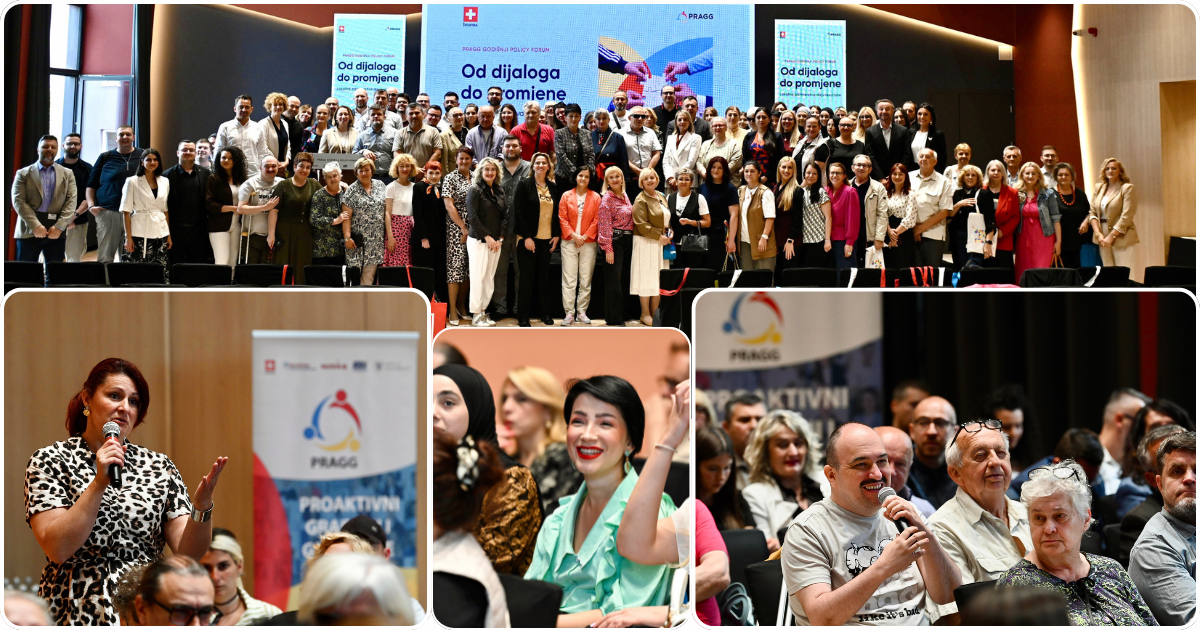
Sarajevo, 3 June 2026 - Trust between citizens, civil society organisations and institutions is not built through grand words, but through concrete cooperation that makes people's everyday lives easier. This was one of the central messages of the two-day PRAGG programme held in Sarajevo, which brought together representatives of civil society organisations, institutions, local communities, international partners, media and academia from across Bosnia and Herzegovina through the PRAGG Forum and the Civil Society Assembly.
Through open discussions, the exchange of experiences and practical examples, participants spoke about the challenges civil society organisations face on a daily basis, as well as cooperation models that are already demonstrating that change is possible when there is a shared commitment to addressing citizens’ concerns together.
“Through the PRAGG programme, we have seen that citizens genuinely want to participate in driving change. Although trust may have been weakened, the positive approach of civil society organisations enables citizens to experience that participation matters and can lead to tangible results, unlike passive activism on social media, which is often not constructive. Through concrete action within communities and meaningful engagement, real change can happen,” said Maja Zarić, Portfolio Manager for Local Governance and Municipal Services at the Embassy of Switzerland in Bosnia and Herzegovina.
She added that the project supports civil society organisations in mobilising citizens to actively engage in decision-making processes and in setting priorities for local development at both local and other levels of government. Particular emphasis is placed on socially excluded groups, as well as the participation of women and young people.
“Through the Forum, we wanted to create a space for dialogue between civil society organisations, institutions and citizens, and to strengthen communication and cooperation. We expect the Forum’s outcomes to help define the next steps for enhancing the participation of civil society in democratic processes,” she emphasised.
The first day was dedicated to the PRAGG Civil Society Assembly – a working space for organisations and initiatives that operate daily within local communities. Discussions focused on issues that directly affect their work and their relationship with institutions, including funding, administrative procedures, data protection, cooperation among organisations, and the need for greater trust and more continuous dialogue with authorities. Special attention was given to examples of good practice and concrete experiences from communities across Bosnia and Herzegovina.
The PRAGG Civil Society Assembly laid the groundwork for the dialogue that continued on the second day through the PRAGG Forum, bringing together around 100 participants from different sectors around a common question: how to make cooperation between civil society and institutions more functional, transparent and beneficial for citizens.
“The most important aspect of this gathering is that it focused on practical experiences – real challenges faced by people and solutions that have already proven effective. Such discussions restore confidence that cooperation can indeed lead to change. In reality, we are all agents of change within society, and without cooperation and partnership, there is only so much we can achieve,” said Božidar Jović, representative of the Citizens’ Association Demos and the PRAGG initiative aimed at increasing the number of persons with disabilities employed in the public sector of the Brčko District of Bosnia and Herzegovina.
During this year’s Forum, participants particularly highlighted the need for greater transparency, fairer and clearer funding models, stronger citizen participation in decision-making processes, and the development of partnerships that can generate long-term and measurable impact in local communities.
“When people from different sectors are given the opportunity to openly discuss problems and jointly seek solutions, dialogue gains real value. It is precisely these kinds of partnerships that can lead to tangible changes citizens can feel in their communities. The initiatives we are implementing and have launched through PRAGG clearly demonstrate that the joint engagement of citizens, civil society organisations and authorities is essential for achieving positive social change,” stated Selma Sijerčić Dilber, PRAGG Project Manager.
The conclusions and recommendations emerging from the PRAGG Forum and the Civil Society Assembly will serve as an important contribution to future efforts aimed at strengthening cooperation between civil society and institutions in Bosnia and Herzegovina, with the goal of creating an environment in which citizens have more opportunities for their voices to be heard and translated into concrete change.
PRAGG is funded by the Government of Switzerland and implemented by HELVETAS and NIRAS in partnership with local partners, the Centres for Civic Initiatives (CCI) and the Institute for Youth Development KULT.
Please wait...