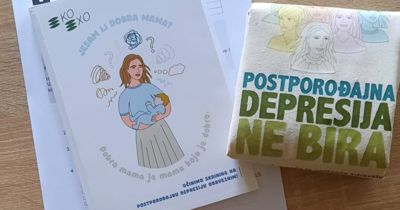
Postpartum depression has remained an invisible topic in Bosnia and Herzegovina for years, left to private conversations, stigma, and women’s individual coping mechanisms. Although it affects a large number of mothers and can have serious consequences for women’s health, child development, and family functioning, early assessment of the mental health of mothers has long been absent from the organized healthcare system in most parts of the country.
Through the campaign “Advocating for the Introduction of Postpartum Depression Screening in BiH”, the organization EKO EHO – Center for Education and Promotion of Healthy Living, with the support of the PRAGG project, initiated a process that moved this topic from the private sphere to the public and institutional space. Through cooperation with healthcare professionals, institutions, civil society organizations, and women who spoke publicly about their own experiences, the initiative contributed to changing the way maternal mental health is discussed, as well as to concrete institutional developments in certain parts of BiH.
This interview with Jelena Mihić Salapura from the organization EKO EHO tells the story of how real change in community behavior begins when citizens' experiences become part of the public dialogue, and the system begins to recognize problems that have remained invisible for years.
What initially inspired you to launch the initiative to introduce screening for postpartum depression in BiH, and what was the situation like before the campaign began?
The initiative arose from direct contact with women who were going through postpartum depression, who were often not recognized or received adequate support in the health system. A large number of mothers contacted us only when the symptoms had already seriously impaired their mental health, partner relationships, and daily functioning. At the same time, we noticed that women's mental health after childbirth was rarely discussed systematically, nor was there an organized way of early recognition of the problem.
Before the campaign began, postpartum depression was mainly seen as a private problem for women, and not as a public health issue. There were no organized screening procedures, except for a short time in the territory of the Republic of Srpska; women often did not know who to turn to, and health workers did not have uniform guidelines or an obligation to assess the mental state of postpartum women. Therefore, we considered it necessary to initiate institutional changes that would enable early recognition and timely support for women.
To what extent did women's personal experiences and stories from practice influence the shaping of this initiative and its positioning as a public health, but also a social issue?
Women's personal experiences were one of the most important foundations of this initiative. It was through their stories that it became clear how serious the consequences of postpartum depression can be, not only for the mother, but also for the child, the family, and the wider community. Many women spoke of feelings of guilt, isolation, and fear of being judged if they admitted that they were having a difficult time during a period that society often presents exclusively as the "happiest period of life".
These stories showed us that postpartum depression is not an individual weakness, but a health problem that requires a systemic response. That is why we insisted that the topic not be kept only within the framework of support for individual women, but that it become part of public health policies and institutional procedures.
What was your approach to advocacy like, which key actors did you involve and how did you manage to bring the topic of postpartum depression from the private sphere to the public and institutional space?
Our approach to advocacy was based on connecting women's experiences, professional arguments and institutional dialogue. From the beginning, we tried to include health workers, mental health centers, health centers, ministries of health, health insurance funds, government representatives and civil society organizations.
We organized meetings, panel discussions, media campaigns and direct conversations with institutions. It was especially important to us that postpartum depression be discussed publicly, professionally and without stigma. When institutions hear women's experiences together with practical data and expert recommendations, it is much easier for them to understand why screening is important.
I think one of the key developments was precisely the fact that the topic moved from private conversations between women to institutions, parliaments, health institutions and public spaces.
What specific changes have you noticed in the approach of institutions during the campaign, from the first reactions to today's steps, including those environments where concrete progress has been made, but also those in which changes have not yet begun or are encountering resistance (FBiH)?
At the beginning, we often encountered a lack of understanding of the importance of the problem or an attitude that there was no capacity to introduce screening. However, during the campaign, we noticed a significant change in the approach of institutions, especially in the Republika Srpska and the Brčko District, where certain health institutions have already started implementing screening or activities to introduce it institutionally.
Today, institutions are much more open about maternal mental health, seeking information about screening models and showing a willingness to cooperate. However, there are also environments where the process is still slow, mainly due to administrative procedures, lack of financial resources or the fact that mental health is still not high enough on the list of health policy priorities.
In the Federation of BiH, we are still waiting for more concrete institutional steps, despite the support of certain political actors and experts.
Have the attitudes and practices of healthcare professionals changed when it comes to recognizing and treating postpartum depression, and in what way?
We have noticed that healthcare professionals are now much more open about postpartum depression than they were before. In settings where screening has been introduced or where training has been provided, experts have begun to pay more attention to the emotional state of pregnant women and mothers, rather than just their physical health.
Healthcare professionals are also increasingly emphasizing the need for additional education, clear procedures, and better cooperation between gynecology, family medicine, and mental health centers. This shows that awareness of the importance of early recognition of the problem has increased significantly.
How much has the behavior and willingness of women and families to talk about postpartum depression and seek help changed during the campaign? Can you share a specific example of this change?
We see that women today are more willing to talk about their experiences and seek help than they were a few years ago. Previously, many women felt ashamed or afraid that they would be labeled “bad mothers” if they admitted that they were struggling psychologically with the postpartum period.
Today, we are increasingly being approached by women who recognize symptoms in themselves and want to talk or seek professional support. We also notice that family members, especially partners, are increasingly recognizing the importance of a mother's mental health.
It is especially important when women who have experienced postpartum depression speak out about it publicly. Such examples, such as those we have seen in our panel discussions, or in joint media appearances with mothers who shared their experiences, often encourage other women to seek help much earlier.
What were the key moments in this initiative that led to real progress, what would you single out as turning points?
One of the most important turning points was establishing cooperation with health institutions that were willing to start implementing screening and show that it is possible to implement it in our system.
Also very important were public events and panel discussions in which experts, institutions and women with personal experience participated together. It was precisely these meetings that contributed to the topic gaining a human dimension and ceasing to be viewed only as a statistic or an individual case.
Today, we are already seeing concrete institutional steps, especially in the Republika Srpska and the Brčko District. What do these developments mean in practice for women and the health system?
These developments mean that women have a better chance of being recognized in time and referred to support before problems become more serious. This is important not only for the mental health of the mother, but also for the healthy development of the child and the functioning of the family.
For the health system, this means a shift from solely reacting to problems to preventive action. Screening allows for early detection of risks and can reduce the need for more complex and expensive forms of treatment in the long run.
Given that access to screening still depends on the place of residence, what are the consequences for women and how important is it to standardize the system throughout BiH?
This currently means that rights and access to support depend on where a woman lives, which should not be the case when it comes to basic health care. Women in some environments have the opportunity to recognize problems early and be referred to support, while in others this opportunity still does not exist.
Therefore, it is very important to establish a uniform system throughout Bosnia and Herzegovina, so that every woman, regardless of her place of residence, has an equal opportunity to receive support and assistance in a timely manner.
From today's perspective, what do you consider to be the biggest change that this initiative has brought, not only in a formal sense, but in the way institutions, healthcare professionals and society as a whole think?
The biggest change is that postpartum depression is now discussed more openly, seriously and with much more understanding than before. Maternal mental health is no longer a completely invisible topic.
Institutions today recognize that it is an important public health issue, healthcare professionals are showing greater sensitivity to the problem, and women increasingly feel that they have the right to seek help without fear of judgment.
Although there is still a lot of work ahead of us, I think the most important thing is that we have made a move from silence and stigma to conversation, understanding and concrete institutional steps.
Although complete systemic solutions have not yet been established throughout Bosnia and Herzegovina, the progress made by Eko Eho through this campaign shows how joint action by civil society organizations, experts, institutions and citizens themselves can initiate long-term changes in the way the system thinks, approaches and operates. It is precisely such changes that represent the essence of the PRAGG approach: Empowering local initiatives that, through dialogue, advocacy and community involvement, contribute to the creation of more just, accountable and inclusive policies and practices.