You may have found yourself at some point in your life in a situation where, for various reasons, you needed legal assistance but were unable to afford a lawyer. Perhaps you later learned that your city has an Institute for Free Legal Aid, where you can receive free legal counselling or more concrete legal support. And indeed, such institutions do exist in our country—everywhere except the Herzegovina-Neretva Canton and the Central Bosnia Canton—until recently.
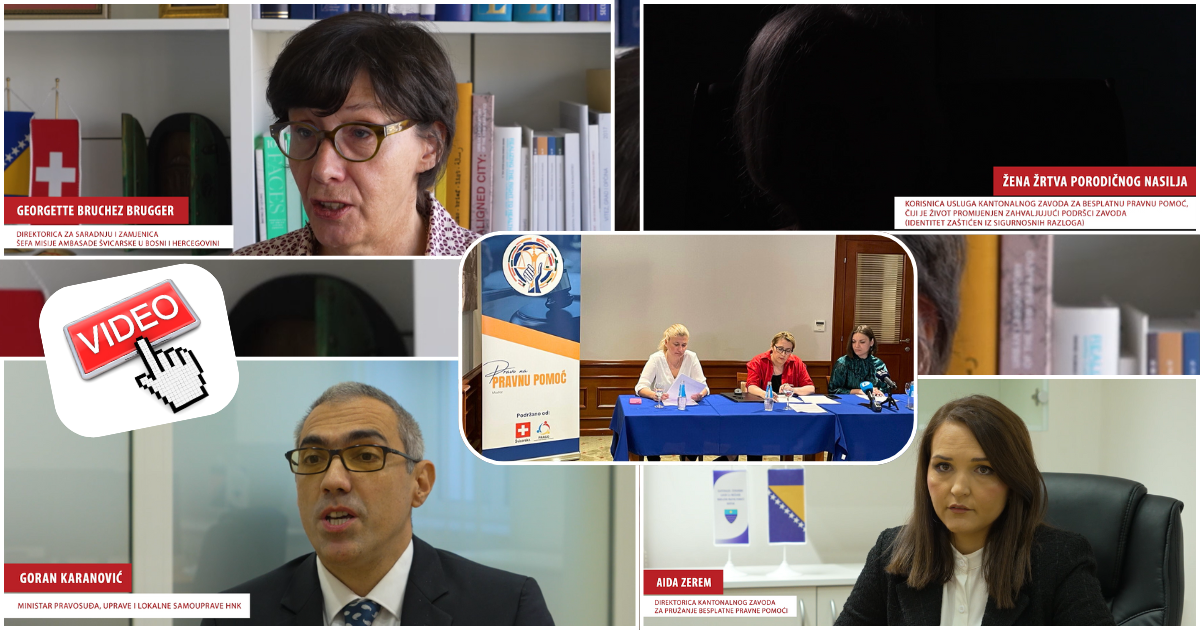
However, an important and significant step has now been taken, thanks to the representatives of the Association for Education and Development Dignitet and the Nansen Dialogue Center (NDC) Mostar. With the support of PRAGG, they launched the campaign “The Right to Legal Aid – Mostar”, with the goal of encouraging the competent institutions to finally unblock this process and enable the already established, but non-operational, Institute to begin working. And they succeeded! The story is given special value by the testimony of an Institute beneficiary—a woman who is a survivor of domestic violence, whose identity is protected. Her experience clearly shows just how much accessible legal aid means at critical moments in life:
“I think that anyone who comes here will feel relieved, will know where to turn and what to do. I am not alone.”
Georgette Bruchez Brugger, Head of Cooperation and Deputy Head of Mission at the Embassy of Switzerland in Bosnia and Herzegovina, highlighted the importance of citizens’ voices in reform processes:
“We believe it is crucial to place the voice of citizens at the centre of this process. Drawing on our experience of a unique and specific system of direct democracy, Switzerland supports authorities, civil society, and citizens in Bosnia and Herzegovina in key reform processes.”
Edisa Demić, representative of the PRAGG initiative “The Right to Legal Aid – Mostar” and Director of the Dignitet Association, emphasized the lasting value of this initiative:
“Thank you to PRAGG and to the Embassy of Switzerland in BiH for making this possible. This was a small grant, but as I have said many times, for me this is about much more than PRAGG and more than a project. It is something that has resolved—and continues to resolve—very important issues within our society. Even if our organization were to close tomorrow, this Institute would remain as a permanent public good.”
Goran Karanović, Minister of Justice, Administration and Local Self-Government of the Herzegovina-Neretva Canton, added:
“We are all part of one society, and through joint work, commitment, and dedication, society as a whole moves forward. The Institute for Free Legal Aid is just one such positive example, and the more of them there are, the better our society will be as a place to live for all of us.”
Director of the Institute, Aida Zerem, explained in more detail who the Institute’s beneficiaries are and how they can exercise their right to free legal aid:
“Beneficiaries are persons belonging to certain socially vulnerable categories—those who have a specific legal status in accordance with Article 11 of the Law on Free Legal Aid. These may include children without parental care, legally incapacitated persons, beneficiaries of social protection, recipients of social assistance under the Law on Social Protection, pensioners with the lowest incomes who have no other household members to support them, war veterans with disabilities, demobilized soldiers, and other individuals in poor financial circumstances. Citizens can contact us in person at the Institute’s premises at Alekse Šantića Street No. 8 in Mostar. The headquarters is in Mostar, and the Institute operates at the cantonal level.”
After more than a decade, everyone in the Herzegovina-Neretva Canton who previously had nowhere to turn for free legal aid has finally gained access to a right guaranteed by law. This is just one example of how local initiatives, launched by citizens themselves, can contribute to positive change and demonstrate that anything is possible when people come together and act jointly.
The PRAGG project is funded by the Government of Switzerland and implemented by the HELVETAS and NIRAS consortium in Bosnia and Herzegovina, in partnership with local partners—the Centres for Civic Initiatives (CCI) and the Institute for Youth Development KULT.
👥 PRAGG unites
🗣 PRAGG advocates
⚖ PRAGG brings change
✔ PRAGG delivers results